रासायनिक साम्य, ऊष्मागतिकी, Electrochemistry एवं Chemical Kinetics | Chemistry Notes
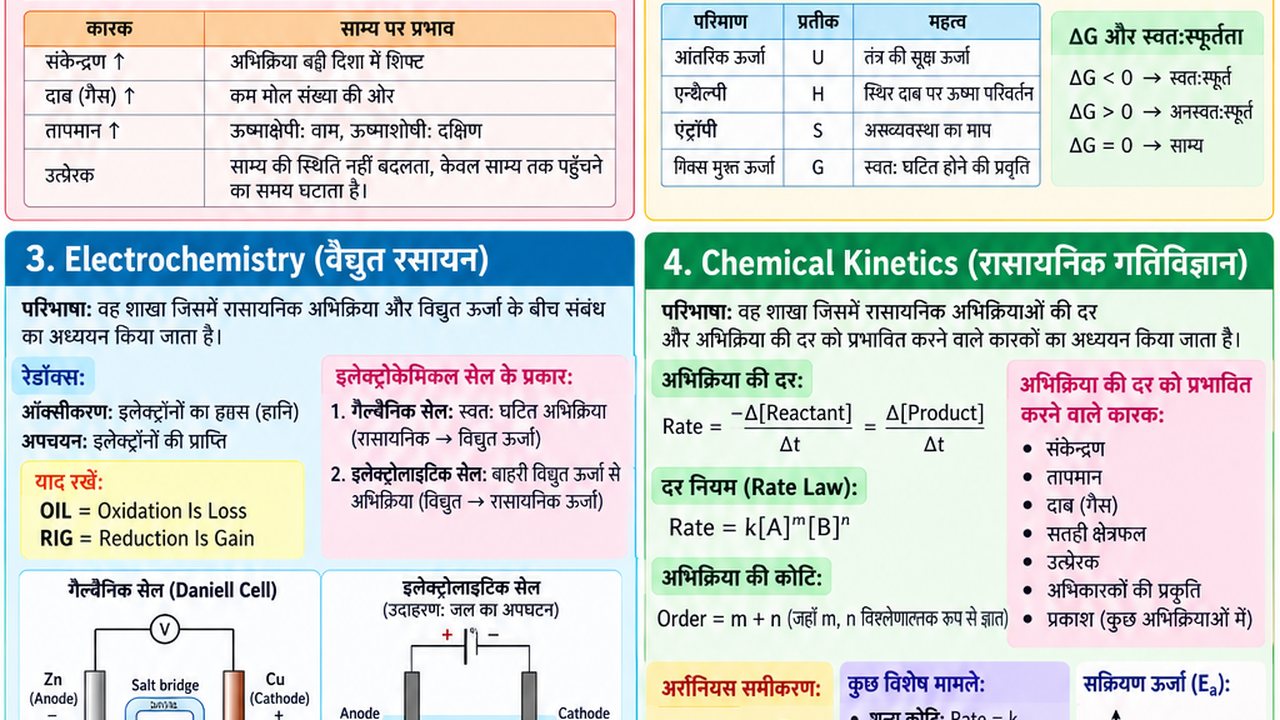
रासायनिक साम्य, ऊष्मागतिकी की मूल बातें, Electrochemistry एवं Chemical Kinetics
Chemistry में केवल यह जानना पर्याप्त नहीं है कि कोई reaction होती है या नहीं। कई बार यह जानना भी जरूरी होता है कि reaction कितनी तेजी से होगी, किस दिशा में आगे बढ़ेगी, कब equilibrium स्थापित होगा और reaction के दौरान energy का क्या परिवर्तन होगा।
उदाहरण के लिए, कुछ chemical reactions बहुत तेजी से होती हैं, जैसे acid और base की neutralization reaction, जबकि कुछ reactions बहुत धीमी होती हैं, जैसे iron पर rust का बनना। इसी तरह कुछ reactions में heat release होती है और कुछ reactions heat absorb करती हैं।
यही concepts हमें Chemical Equilibrium, Thermodynamics, Electrochemistry और Chemical Kinetics के माध्यम से समझ में आते हैं।
Chemical Equilibrium हमें बताता है कि reversible reaction में forward और backward reaction किस स्थिति में balance होती हैं।
Thermodynamics reaction में heat, work और energy के परिवर्तन का अध्ययन करती है।
Electrochemistry chemical energy और electrical energy के बीच संबंध को समझाती है।
वहीं Chemical Kinetics यह बताती है कि कोई chemical reaction कितनी तेजी से होती है और reaction की rate किन factors से प्रभावित होती है।
Competitive exams में इन topics से equilibrium constant, Le Chatelier's principle, thermodynamic laws, enthalpy, Gibbs free energy, oxidation-reduction, galvanic cell, electrolytic cell, electrode potential, Faraday's laws, reaction rate, order और activation energy से जुड़े प्रश्न पूछे जाते हैं।
इस article में इन सभी concepts को आसान भाषा, examples, tables, formulas, short notes और important one-liners के साथ समझाया गया है।
रासायनिक साम्य (Chemical Equilibrium)
जब कोई reversible chemical reaction आगे और पीछे दोनों दिशाओं में हो सकती है, तो कुछ समय बाद ऐसी स्थिति आ सकती है जहाँ forward reaction और backward reaction की rates बराबर हो जाती हैं।
इस अवस्था को Chemical Equilibrium (रासायनिक साम्य) कहते हैं।
सरल शब्दों में:
जब reversible reaction में forward और backward reactions की rates बराबर हो जाती हैं, तो system equilibrium में होता है।
ध्यान रखें कि equilibrium का अर्थ reaction का रुक जाना नहीं है।
यह एक Dynamic Equilibrium होता है।
Reversible Reaction
जिस chemical reaction को forward और backward दोनों directions में लिखा जा सकता है, उसे reversible reaction कहते हैं।
इसे सामान्यतः:
A + B ⇌ C + D
से दर्शाते हैं।
यहाँ:
-
Forward reaction: A + B → C + D
-
Backward reaction: C + D → A + B
Dynamic Equilibrium
Equilibrium में:
Rate of Forward Reaction = Rate of Backward Reaction
लेकिन reactants और products की concentrations जरूरी नहीं कि बराबर हों।
इसलिए:
Equilibrium ≠ Equal Concentration
बल्कि:
Equilibrium = Equal Reaction Rates
Equilibrium Constant
किसी reversible reaction के equilibrium की स्थिति को एक numerical value द्वारा व्यक्त किया जा सकता है, जिसे Equilibrium Constant (K) कहते हैं।
सामान्य reaction:
aA + bB ⇌ cC + dD
के लिए:
Kc = [C]ᶜ[D]ᵈ / [A]ᵃ[B]ᵇ
यहाँ square brackets equilibrium concentration को दर्शाते हैं।
Kc का अर्थ
यदि Kc का मान बहुत बड़ा है, तो equilibrium में products की मात्रा comparatively अधिक हो सकती है।
यदि Kc का मान बहुत छोटा है, तो reactants की मात्रा comparatively अधिक हो सकती है।
ध्यान दें कि K का exact interpretation reaction और conditions पर निर्भर करता है।
Le Chatelier's Principle
यदि equilibrium में उपस्थित किसी system पर concentration, pressure या temperature में परिवर्तन किया जाए, तो equilibrium उस परिवर्तन के प्रभाव को कम करने वाली दिशा में shift करने की tendency रखता है।
इसे Le Chatelier's Principle कहते हैं।
Concentration का प्रभाव
यदि किसी reaction में reactant की concentration बढ़ाई जाए, तो equilibrium सामान्यतः products की दिशा में shift करने की tendency रखता है।
उदाहरण:
N₂ + 3H₂ ⇌ 2NH₃
यदि N₂ या H₂ की concentration बढ़ाई जाए, तो equilibrium NH₃ बनने की दिशा में shift करने की tendency रखता है।
यदि product की concentration बढ़ाई जाए, तो equilibrium reactants की दिशा में shift करने की tendency रखता है।
Pressure का प्रभाव
Gas reactions में pressure का प्रभाव महत्वपूर्ण होता है।
उदाहरण:
N₂ + 3H₂ ⇌ 2NH₃
Left side पर total gaseous moles:
1 + 3 = 4
Right side पर:
2 moles
इसलिए pressure बढ़ाने पर equilibrium सामान्यतः कम gaseous moles वाली दिशा में shift करने की tendency रखता है।
अर्थात ammonia formation की दिशा में।
Temperature का प्रभाव
Temperature बदलने पर equilibrium constant भी बदल सकता है।
यदि forward reaction exothermic है, तो heat को product की तरह माना जा सकता है।
Reactants ⇌ Products + Heat
Temperature बढ़ाने पर equilibrium heat को absorb करने वाली दिशा में shift करने की tendency रखता है।
यदि forward reaction endothermic है:
Reactants + Heat ⇌ Products
तो temperature बढ़ाने पर products की दिशा में shift की tendency हो सकती है।
Catalyst का Equilibrium पर प्रभाव
Catalyst forward और backward दोनों reactions की rate को बढ़ा सकता है।
लेकिन सामान्यतः catalyst equilibrium position या equilibrium constant को नहीं बदलता।
यह केवल equilibrium तक पहुँचने में लगने वाला समय कम करता है।
Ionic Equilibrium
जब aqueous solution में ions से संबंधित equilibrium स्थापित होता है, तो इसे Ionic Equilibrium कहते हैं।
उदाहरण:
CH₃COOH ⇌ H⁺ + CH₃COO⁻
Weak electrolytes में ionization incomplete होता है और equilibrium establish हो सकता है।
Thermodynamics क्या है?
Thermodynamics Chemistry की वह branch है जिसमें heat, work, energy और उनके बीच होने वाले transformations का अध्ययन किया जाता है।
Chemical reaction के दौरान system energy absorb कर सकता है या release कर सकता है।
System और Surroundings
System:
जिस part का हम अध्ययन कर रहे हैं।
Surroundings:
System के बाहर का बाकी environment।
उदाहरण:
यदि हम किसी beaker में होने वाली chemical reaction का अध्ययन कर रहे हैं, तो reaction mixture system हो सकता है और beaker के बाहर का environment surroundings।
Thermodynamic System के प्रकार
Open System
जिसमें matter और energy दोनों का exchange surroundings के साथ हो सकता है।
उदाहरण:
खुला हुआ container।
Closed System
जिसमें energy का exchange हो सकता है लेकिन matter का exchange नहीं होता।
उदाहरण:
एक properly sealed container।
Isolated System
जिसमें न matter और न ही energy का exchange होता है।
Ideal thermodynamic example:
Perfectly insulated closed container
State Functions
ऐसी thermodynamic quantities जिनका change केवल initial और final state पर निर्भर करता है, उन्हें State Functions कहते हैं।
उदाहरण:
-
Internal Energy (U)
-
Enthalpy (H)
-
Entropy (S)
-
Gibbs Free Energy (G)
Heat और Work state functions नहीं हैं।
Internal Energy
System के अंदर मौजूद microscopic energy के total को Internal Energy (U) कहा जाता है।
Internal energy में molecules की translational, rotational, vibrational तथा bonding-related energy आदि contributions शामिल हो सकती हैं।
Change in internal energy:
ΔU = U₂ − U₁
First Law of Thermodynamics
First Law energy conservation principle पर आधारित है।
Energy can neither be created nor destroyed; it can only be transformed from one form to another.
Chemistry में एक common convention के अनुसार:
ΔU = q + w
जहाँ:
-
ΔU = Internal Energy Change
-
q = Heat supplied to system
-
w = Work done on system
Enthalpy
Constant pressure conditions में heat change को व्यक्त करने के लिए Enthalpy (H) बहुत उपयोगी quantity है।
H = U + PV
Enthalpy change:
ΔH = H₂ − H₁
Constant pressure पर:
ΔH = qₚ
Exothermic और Endothermic Process
Exothermic
जिस process में system surroundings को heat release करता है:
ΔH < 0
उदाहरण:
Combustion reactions।
Endothermic
जिस process में system surroundings से heat absorb करता है:
ΔH > 0
उदाहरण:
कुछ decomposition processes।
Entropy
किसी system में energy dispersion या randomness/disorder को describe करने वाली thermodynamic quantity को Entropy (S) कहते हैं।
Entropy change:
ΔS = S₂ − S₁
सामान्यतः gas particles की संख्या बढ़ने पर entropy बढ़ने की tendency होती है।
उदाहरण:
Solid → Liquid → Gas
इस दिशा में molecular freedom सामान्यतः बढ़ती है।
Gibbs Free Energy
किसी process की spontaneity का अनुमान लगाने के लिए Gibbs Free Energy (G) बहुत महत्वपूर्ण है।
Formula:
ΔG = ΔH − TΔS
जहाँ:
-
ΔG = Gibbs Free Energy Change
-
ΔH = Enthalpy Change
-
T = Absolute Temperature
-
ΔS = Entropy Change
ΔG और Spontaneity
सामान्य conditions में:
ΔG < 0 → Spontaneous process
ΔG > 0 → Non-spontaneous process
ΔG = 0 → Equilibrium
यहाँ spontaneous का अर्थ यह है कि process thermodynamically favorable हो सकता है; इसका अर्थ यह नहीं है कि reaction necessarily fast होगी।
Thermodynamics के प्रमुख नियम
| Law | मुख्य विचार |
|---|---|
| Zeroth Law | Thermal equilibrium की concept |
| First Law | Energy conservation |
| Second Law | Entropy और direction of spontaneous processes |
| Third Law | Perfect crystal की entropy का absolute zero के पास behavior |
Zeroth Law of Thermodynamics
यदि system A, system B के thermal equilibrium में है और system B, system C के thermal equilibrium में है, तो A और C भी thermal equilibrium में होंगे।
यह temperature की concept का आधार है।
Second Law of Thermodynamics
Second Law processes की direction और entropy से संबंधित है।
एक isolated system में spontaneous process के दौरान total entropy decrease नहीं करती।
सरल रूप में:
Spontaneous process → Total entropy tends to increase
Third Law of Thermodynamics
Perfect crystal की entropy absolute zero temperature के निकट एक निश्चित minimum value की ओर जाती है, और ideal perfect crystal के लिए इसे zero माना जाता है।
Electrochemistry क्या है?
Electrochemistry Chemistry की वह branch है जिसमें chemical reactions और electrical energy के बीच संबंध का अध्ययन किया जाता है।
इसमें दो प्रमुख processes शामिल हैं:
-
Chemical energy → Electrical energy
-
Electrical energy → Chemical energy
Oxidation और Reduction
Electrochemistry को समझने के लिए oxidation और reduction की concept महत्वपूर्ण है।
Oxidation → Electron Loss
Reduction → Electron Gain
इन दोनों processes के साथ होने वाली reaction को Redox Reaction कहते हैं।
Electrochemical Cell
ऐसा device जिसमें redox reaction और electrical energy के बीच conversion होता है, उसे Electrochemical Cell कहते हैं।
इसके दो प्रमुख प्रकार हैं:
-
Galvanic/Voltaic Cell
-
Electrolytic Cell
Galvanic Cell
Galvanic cell में spontaneous redox reaction से electrical energy उत्पन्न होती है।
अर्थात:
Chemical Energy → Electrical Energy
उदाहरण:
Daniell Cell
इसमें Zinc और Copper electrodes का उपयोग किया जाता है।
Overall reaction:
Zn + Cu²⁺ → Zn²⁺ + Cu
Anode और Cathode
Electrochemical cells में:
Anode → Oxidation
Cathode → Reduction
यह नियम दोनों प्रकार के electrochemical cells में लागू होता है।
याद रखने का आसान तरीका:
AnOx = Anode Oxidation
RedCat = Reduction Cathode
Galvanic Cell में Electrode Sign
Galvanic cell में:
-
Anode = Negative
-
Cathode = Positive
लेकिन oxidation हमेशा anode पर और reduction हमेशा cathode पर होती है।
Electrolytic Cell
Electrolytic cell में external electrical energy का उपयोग करके non-spontaneous chemical reaction कराई जाती है।
अर्थात:
Electrical Energy → Chemical Energy
उदाहरण:
Water electrolysis या molten ionic compounds का electrolysis।
Electrolytic cell में:
-
Anode = Positive
-
Cathode = Negative
लेकिन:
Anode → Oxidation
Cathode → Reduction
हमेशा यही रहता है।
Electrolyte
ऐसा पदार्थ जो molten या aqueous state में ions के कारण electricity conduct कर सके, उसे Electrolyte कहते हैं।
उदाहरण:
-
NaCl solution
-
HCl solution
-
CuSO₄ solution
Electrode Potential
किसी electrode की oxidation या reduction की tendency को electrode potential से relate किया जाता है।
Standard conditions में इसे Standard Electrode Potential (E°) के रूप में व्यक्त किया जाता है।
Standard Hydrogen Electrode को reference electrode के रूप में उपयोग किया जाता है।
इसका standard electrode potential:
E° = 0.00 V
Cell Potential
किसी electrochemical cell का standard cell potential:
E°cell = E°cathode − E°anode
यदि E°cell positive है, तो reaction standard conditions में thermodynamically favorable/spontaneous direction में हो सकती है।
Electrochemical Series
Elements/electrodes को उनके standard reduction potentials के आधार पर व्यवस्थित किया जा सकता है।
इसे Electrochemical Series कहा जाता है।
इससे oxidation-reduction की tendency तथा displacement reactions के बारे में जानकारी मिलती है।
Faraday's Laws of Electrolysis
Electrolysis के दौरान deposited या liberated substance की मात्रा electrical charge से संबंधित होती है।
First Law
Electrolysis के दौरान deposited substance का mass passed electricity के quantity के proportional होता है।
m ∝ Q
और:
Q = It
जहाँ:
-
Q = Charge
-
I = Current
-
t = Time
इसलिए:
m ∝ It
Second Law
जब समान quantity of electricity विभिन्न electrolytes से pass की जाती है, तो deposited substances के masses उनके equivalent weights के proportional होते हैं।
Chemical Kinetics
Chemical Kinetics Chemistry की वह branch है जिसमें chemical reactions की rate और reaction rate को प्रभावित करने वाले factors का अध्ययन किया जाता है।
Rate of Reaction
किसी reaction में reactant या product की concentration में unit time के दौरान होने वाले परिवर्तन को Rate of Reaction कहते हैं।
Reactant के लिए:
Rate = −Δ[Reactant] / Δt
Product के लिए:
Rate = Δ[Product] / Δt
Reactant के लिए negative sign इसलिए लगाया जाता है क्योंकि उसकी concentration समय के साथ घटती है।
Reaction Rate को प्रभावित करने वाले Factors
Chemical reaction की rate कई factors पर निर्भर करती है:
-
Reactant concentration
-
Temperature
-
Pressure — विशेषकर gases में
-
Surface area
-
Catalyst
-
Nature of reactants
-
Light — कुछ photochemical reactions में
Concentration का प्रभाव
Reactants की concentration बढ़ाने पर particles के collisions की frequency बढ़ सकती है।
इससे reaction rate सामान्यतः बढ़ सकती है।
Temperature का प्रभाव
Temperature बढ़ाने पर particles की kinetic energy बढ़ती है।
इससे अधिक particles activation energy barrier पार कर सकते हैं और reaction rate बढ़ सकती है।
Surface Area का प्रभाव
Solid reactant को छोटे particles में divide करने पर surface area बढ़ जाता है।
इससे reaction rate बढ़ सकती है।
उदाहरण:
Powdered calcium carbonate, बड़े marble pieces की तुलना में acid के साथ अधिक तेजी से reaction कर सकता है, समान परिस्थितियों में।
Catalyst
Catalyst वह पदार्थ है जो reaction की rate को बदलता है और reaction के अंत में overall रूप से स्वयं स्थायी रूप से consume नहीं होता।
Catalyst सामान्यतः reaction के लिए एक alternative pathway प्रदान करता है जिसकी activation energy कम होती है।
Activation Energy
Reaction को शुरू करने के लिए reactant molecules को minimum required energy barrier पार करनी पड़ती है।
इसे Activation Energy (Ea) कहते हैं।
Catalyst सामान्यतः activation energy को कम करता है।
Collision Theory
Collision Theory के अनुसार chemical reaction तब हो सकती है जब reactant particles:
-
एक-दूसरे से collide करें।
-
पर्याप्त energy के साथ collide करें।
-
उचित orientation के साथ collide करें।
ऐसे collisions को Effective Collisions कहा जाता है।
Rate Law
किसी reaction की rate को reactants की concentration से relate करने वाले mathematical expression को Rate Law कहते हैं।
उदाहरण:
aA + bB → Products
तो:
Rate = k[A]ᵐ[B]ⁿ
जहाँ:
-
k = Rate Constant
-
[A] और [B] = Reactant concentrations
-
m और n = experimentally determined powers
Order of Reaction
Rate law में concentration terms की powers का sum reaction का Order कहलाता है।
यदि:
Rate = k[A]²[B]
तो:
Order = 2 + 1 = 3
इसलिए reaction third order की होगी।
Zero Order Reaction
यदि rate concentration पर depend नहीं करती:
Rate = k
तो reaction zero order कहलाती है।
First Order Reaction
यदि:
Rate = k[A]
तो reaction first order कहलाती है।
First-order reaction का half-life:
t₁/₂ = 0.693/k
Second Order Reaction
यदि:
Rate = k[A]²
तो reaction second order कहलाती है।
Half-Life
किसी reaction में reactant की initial concentration को आधा होने में जितना समय लगता है, उसे Half-Life (t₁/₂) कहते हैं।
First-order reaction के लिए:
t₁/₂ = 0.693/k
महत्वपूर्ण बात:
First-order reaction की half-life initial concentration पर depend नहीं करती।
Arrhenius Equation
Reaction rate constant और temperature के बीच संबंध को Arrhenius Equation से व्यक्त किया जाता है:
k = Ae⁻ᴱᵃ/ᴿᵀ
जहाँ:
-
k = Rate constant
-
A = Frequency factor
-
Ea = Activation Energy
-
R = Gas constant
-
T = Absolute temperature
Temperature बढ़ने पर सामान्यतः k बढ़ता है।
Chemical Equilibrium और Kinetics में अंतर
| आधार | Chemical Equilibrium | Chemical Kinetics |
|---|---|---|
| मुख्य विषय | Equilibrium position | Reaction rate |
| प्रमुख प्रश्न | Reaction कहाँ तक जाएगी? | Reaction कितनी तेजी से होगी? |
| प्रमुख concept | K, Le Chatelier Principle | Rate, k, Ea |
| Time | Equilibrium state से संबंधित | Time-dependent |
| Catalyst | Equilibrium position नहीं बदलता | Rate बदल सकता है |
Thermodynamics और Kinetics में अंतर
| आधार | Thermodynamics | Kinetics |
|---|---|---|
| मुख्य focus | Energy और spontaneity | Reaction rate |
| प्रमुख quantities | ΔH, ΔS, ΔG | Rate, k, Ea |
| बताता है | Reaction thermodynamically favorable है या नहीं | Reaction कितनी तेजी से होगी |
| Activation Energy | मुख्य focus नहीं | महत्वपूर्ण |
| Time | सामान्यतः rate नहीं बताती | Time का महत्वपूर्ण role |
Electrochemistry के Important Points
| Concept | याद रखने योग्य बात |
|---|---|
| Oxidation | Electron loss |
| Reduction | Electron gain |
| Anode | Oxidation |
| Cathode | Reduction |
| Galvanic Cell | Chemical → Electrical Energy |
| Electrolytic Cell | Electrical → Chemical Energy |
| Galvanic Anode | Negative |
| Galvanic Cathode | Positive |
| Electrolytic Anode | Positive |
| Electrolytic Cathode | Negative |
| Standard Hydrogen Electrode | E° = 0.00 V |
| Cell Potential | E°cell = E°cathode − E°anode |
| Electrolysis | Electrical energy द्वारा chemical change |
Thermodynamics के Important Formulas
ΔU = q + w
H = U + PV
ΔH = H₂ − H₁
ΔS = S₂ − S₁
ΔG = ΔH − TΔS
ΔG < 0 → Thermodynamically spontaneous
ΔG = 0 → Equilibrium
ΔG > 0 → Non-spontaneous under the stated conditions
Chemical Equilibrium के Important Formulas
General reaction:
aA + bB ⇌ cC + dD
Kc = [C]ᶜ[D]ᵈ / [A]ᵃ[B]ᵇ
Equilibrium condition:
Forward Rate = Backward Rate
Electrochemistry के Important Formulas
Q = It
m ∝ Q
E°cell = E°cathode − E°anode
E°SHE = 0.00 V
Chemical Kinetics के Important Formulas
Rate = −Δ[Reactant]/Δt
Rate = Δ[Product]/Δt
Rate = k[A]ᵐ[B]ⁿ
Order = m + n
First-order reaction:
t₁/₂ = 0.693/k
Arrhenius Equation:
k = Ae⁻ᴱᵃ/ᴿᵀ
Short Notes
Chemical Equilibrium:
Reversible reaction में forward और backward reactions की rates बराबर होने की dynamic अवस्था।
Equilibrium Constant:
Equilibrium की स्थिति को numerical रूप में व्यक्त करने वाली quantity।
Le Chatelier's Principle:
Equilibrium system पर disturbance होने पर system उस disturbance के प्रभाव को कम करने की दिशा में shift करने की tendency रखता है।
Thermodynamics:
Heat, work, energy और उनके transformations का अध्ययन।
Internal Energy:
System की microscopic energy का total।
Enthalpy:
Constant pressure पर heat changes को describe करने वाली thermodynamic quantity।
Entropy:
Energy dispersion/randomness को describe करने वाली thermodynamic quantity।
Gibbs Free Energy:
Spontaneity का thermodynamic criterion देने वाली quantity।
Electrochemistry:
Chemical और electrical energy के बीच संबंध का अध्ययन।
Galvanic Cell:
Spontaneous redox reaction से electrical energy उत्पन्न करता है।
Electrolytic Cell:
Electrical energy की सहायता से chemical reaction कराता है।
Anode:
Oxidation हमेशा anode पर होती है।
Cathode:
Reduction हमेशा cathode पर होती है।
Chemical Kinetics:
Chemical reaction की rate और उसे प्रभावित करने वाले factors का अध्ययन।
Activation Energy:
Reaction के लिए आवश्यक minimum energy barrier।
Catalyst:
Alternative lower-energy pathway देकर reaction की rate बदलने वाला पदार्थ।
Rate Law:
Reaction rate को reactant concentrations से relate करने वाला mathematical expression।
Super Important One-Liners
-
Chemical Equilibrium एक dynamic equilibrium होता है।
-
Equilibrium पर forward और backward reaction rates बराबर होती हैं।
-
Equilibrium पर reactants और products की concentrations जरूरी नहीं कि बराबर हों।
-
Reversible reaction को ⇌ symbol से दर्शाया जाता है।
-
Equilibrium constant को सामान्यतः K से दर्शाते हैं।
-
Kc concentration के आधार पर equilibrium constant है।
-
Le Chatelier's Principle equilibrium shift की tendency बताता है।
-
Catalyst equilibrium constant को सामान्यतः नहीं बदलता।
-
Catalyst equilibrium तक पहुँचने का समय कम कर सकता है।
-
Temperature equilibrium constant को प्रभावित कर सकता है।
-
Thermodynamics heat, work और energy का अध्ययन करती है।
-
First Law energy conservation पर आधारित है।
-
First Law का common chemistry equation ΔU = q + w है।
-
Enthalpy को H से दर्शाया जाता है।
-
H = U + PV।
-
Constant pressure पर ΔH = qp।
-
Exothermic process में ΔH सामान्यतः negative होता है।
-
Endothermic process में ΔH सामान्यतः positive होता है।
-
Entropy को S से दर्शाया जाता है।
-
Gibbs Free Energy को G से दर्शाया जाता है।
-
ΔG = ΔH − TΔS।
-
ΔG < 0 process thermodynamically favorable/spontaneous हो सकती है।
-
ΔG = 0 equilibrium condition से संबंधित है।
-
Electrochemistry chemical और electrical energy के संबंध का अध्ययन है।
-
Oxidation में electron loss होता है।
-
Reduction में electron gain होता है।
-
Oxidation हमेशा anode पर होती है।
-
Reduction हमेशा cathode पर होती है।
-
Galvanic cell chemical energy को electrical energy में बदलता है।
-
Electrolytic cell electrical energy को chemical change में उपयोग करता है।
-
Galvanic cell में anode negative और cathode positive होता है।
-
Electrolytic cell में anode positive और cathode negative होता है।
-
Standard Hydrogen Electrode का E° 0.00 V माना जाता है।
-
E°cell = E°cathode − E°anode।
-
Faraday's First Law में deposited mass charge के proportional होता है।
-
Q = It।
-
Chemical Kinetics reaction rate का अध्ययन करती है।
-
Reaction rate concentration change per unit time है।
-
Temperature बढ़ने पर सामान्यतः reaction rate बढ़ सकती है।
-
Catalyst activation energy को कम करने वाला alternative pathway दे सकता है।
-
Activation Energy को Ea से दर्शाया जाता है।
-
Effective collision में पर्याप्त energy और proper orientation आवश्यक हैं।
-
Rate Law experimentally determined हो सकता है।
-
Rate = k[A]ᵐ[B]ⁿ एक सामान्य rate law है।
-
Rate law में powers का sum reaction order देता है।
-
Zero-order reaction में rate = k।
-
First-order reaction में rate = k[A]।
-
First-order reaction की half-life 0.693/k होती है।
-
Second-order reaction में concentration की power 2 हो सकती है।
-
Arrhenius equation temperature और rate constant का संबंध बताती है।
Quick Revision
Equilibrium → Forward Rate = Backward Rate
Reversible Reaction → A + B ⇌ C + D
Equilibrium Constant → Kc
Le Chatelier → System disturbance के effect को oppose करने की tendency
Catalyst → Equilibrium position नहीं बदलता, equilibrium तक पहुँचने की speed बढ़ा सकता है
Thermodynamics → Heat + Work + Energy
First Law → ΔU = q + w
Enthalpy → H = U + PV
Entropy → S
Gibbs Energy → ΔG = ΔH − TΔS
ΔG < 0 → Thermodynamically spontaneous
Electrochemistry → Chemical ↔ Electrical Energy
Oxidation → Electron Loss
Reduction → Electron Gain
Anode → Oxidation
Cathode → Reduction
Galvanic Cell → Chemical → Electrical
Electrolytic Cell → Electrical → Chemical
E°cell → E°cathode − E°anode
Electrolysis → Q = It
Kinetics → Reaction Rate
Rate → Concentration Change / Time
Rate Law → Rate = k[A]ᵐ[B]ⁿ
Order → m + n
Activation Energy → Ea
Catalyst → Lower Activation Energy Pathway
First Order → t₁/₂ = 0.693/k
Arrhenius → k = Ae⁻ᴱᵃ/ᴿᵀ
परीक्षा के लिए सबसे महत्वपूर्ण Topics
यदि परीक्षा से पहले इस पूरे chapter को जल्दी revise करना हो, तो इन topics पर विशेष ध्यान दें:
-
Chemical Equilibrium की definition
-
Dynamic Equilibrium
-
Equilibrium Constant Kc
-
Le Chatelier's Principle
-
Concentration और Pressure का equilibrium पर प्रभाव
-
Temperature का equilibrium पर प्रभाव
-
Catalyst का प्रभाव
-
Thermodynamics की basic concepts
-
System और Surroundings
-
Open, Closed और Isolated System
-
State Functions
-
First Law of Thermodynamics
-
Internal Energy
-
Enthalpy
-
Entropy
-
Gibbs Free Energy
-
Thermodynamics के चार laws
-
Electrochemistry
-
Galvanic और Electrolytic Cell
-
Anode और Cathode
-
Oxidation और Reduction
-
Electrode Potential
-
Standard Hydrogen Electrode
-
Cell Potential
-
Faraday's Laws
-
Chemical Kinetics
-
Rate of Reaction
-
Factors affecting reaction rate
-
Catalyst
-
Activation Energy
-
Collision Theory
-
Rate Law
-
Order of Reaction
-
Half-Life
-
Arrhenius Equation
Frequently Asked Questions (FAQs)
1. Chemical Equilibrium क्या है?
उत्तर: Reversible reaction में जब forward और backward reactions की rates बराबर हो जाती हैं, तो system Chemical Equilibrium में होता है। यह एक dynamic अवस्था होती है।
2. क्या equilibrium पर reaction रुक जाती है?
उत्तर: नहीं। Equilibrium dynamic होता है। Forward और backward reactions दोनों चलती रहती हैं, लेकिन उनकी rates बराबर हो जाती हैं।
3. Le Chatelier's Principle क्या है?
उत्तर: यदि equilibrium system में concentration, pressure या temperature में परिवर्तन किया जाए, तो system उस परिवर्तन के प्रभाव को कम करने वाली दिशा में shift करने की tendency रखता है।
4. Thermodynamics क्या है?
उत्तर: Thermodynamics Chemistry की वह branch है जिसमें heat, work, energy और उनके transformations का अध्ययन किया जाता है।
5. First Law of Thermodynamics क्या है?
उत्तर: First Law energy conservation principle पर आधारित है। Chemistry में एक common convention के अनुसार:
ΔU = q + w
6. Gibbs Free Energy क्या बताती है?
उत्तर: Gibbs Free Energy reaction की thermodynamic spontaneity का अनुमान लगाने में उपयोगी है।
Formula:
ΔG = ΔH − TΔS
7. Galvanic और Electrolytic Cell में क्या अंतर है?
उत्तर: Galvanic cell spontaneous chemical reaction से electrical energy उत्पन्न करता है, जबकि electrolytic cell external electrical energy का उपयोग करके chemical reaction कराता है।
8. Anode और Cathode पर कौन-सी reaction होती है?
उत्तर:
Anode → Oxidation
Cathode → Reduction
यह नियम galvanic और electrolytic दोनों cells में लागू होता है।
9. Chemical Kinetics क्या है?
उत्तर: Chemical Kinetics Chemistry की वह branch है जिसमें chemical reactions की rate और reaction rate को प्रभावित करने वाले factors का अध्ययन किया जाता है।
10. First-order reaction की half-life का formula क्या है?
उत्तर:
t₁/₂ = 0.693/k
जहाँ k first-order reaction का rate constant है।
निष्कर्ष
Chemical Equilibrium, Thermodynamics, Electrochemistry और Chemical Kinetics Chemistry के ऐसे topics हैं जो reaction की स्थिति, energy, electrical effects और reaction की speed को समझने में महत्वपूर्ण भूमिका निभाते हैं।
Chemical Equilibrium से हमें पता चलता है कि reversible reaction में forward और backward processes किस अवस्था में balance होती हैं। Kc और Le Chatelier's Principle equilibrium के महत्वपूर्ण concepts हैं।
Thermodynamics हमें यह समझने में मदद करती है कि chemical processes में energy का क्या परिवर्तन होता है। ΔU, ΔH, ΔS और ΔG इसके प्रमुख concepts हैं।
Electrochemistry में oxidation-reduction, galvanic cell, electrolytic cell, electrode potential और Faraday's laws विशेष रूप से महत्वपूर्ण हैं।
Chemical Kinetics reaction की speed को समझाती है। Rate, Rate Law, Order, Activation Energy, Catalyst, Half-Life और Arrhenius Equation इस topic के मुख्य concepts हैं।
Competitive exams के लिए विशेष रूप से Kc, Le Chatelier's Principle, ΔU = q + w, ΔG = ΔH − TΔS, Anode-Cathode, E°cell, Faraday's Law, Rate Law, Order और First-order half-life को अच्छी तरह तैयार करना चाहिए।
💬 Leave a Comment & Rating