MS Word Layout Tab
Advertisement
The Layout tab comes right after Design in Word's ribbon (in older Word versions, this was called "Page Layout"). While Design controls the overall visual theme, Layout controls the physical structure of your pages — margins, orientation, columns, spacing, and how objects position on the page.
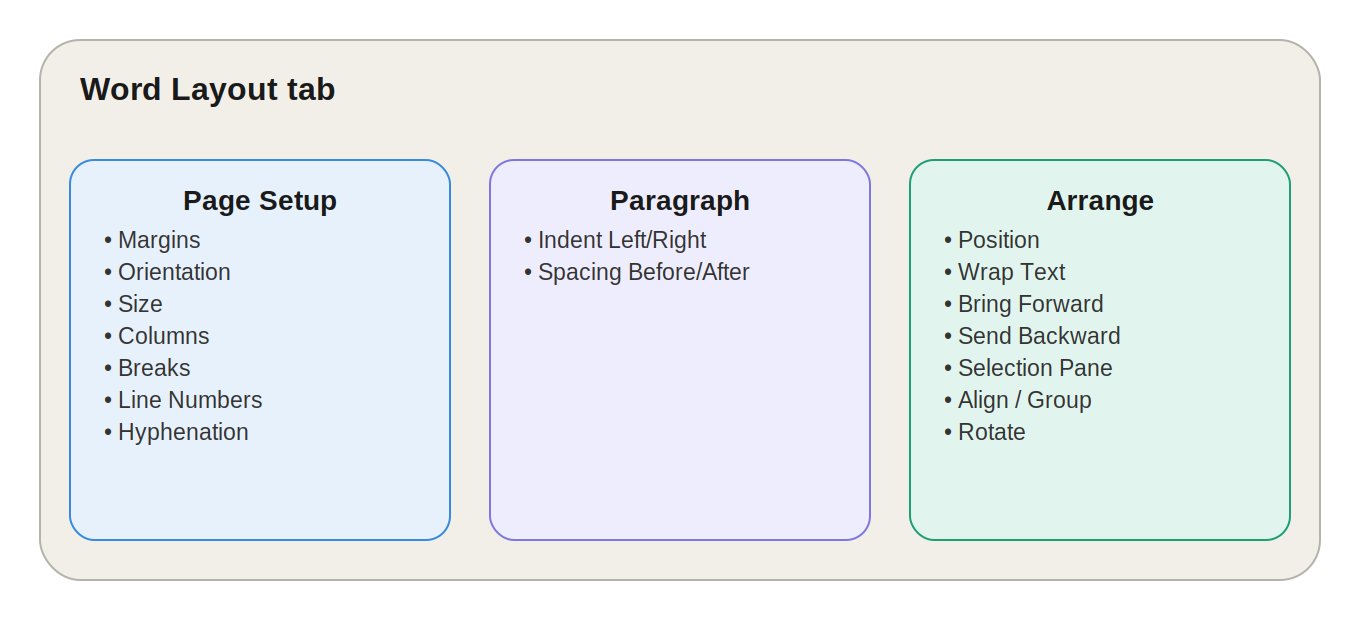
It has three groups: Page Setup, Paragraph, and Arrange.
1. Page Setup Group
Controls the fundamental dimensions and structure of your pages.
- Margins – Sets the blank space around the edges of each page. Choose from presets (Normal, Narrow, Moderate, Wide) or click Custom Margins for exact measurements.
- Orientation – Switches the page between Portrait (tall) and Landscape (wide).
- Size – Changes paper size (Letter, A4, Legal, etc.) for printing purposes.
- Columns – Splits text into multiple newspaper-style columns (One, Two, Three, or custom column widths and spacing).
- Breaks – Inserts different types of breaks: Page Break, Column Break, Text Wrapping Break, or Section Breaks (Next Page, Continuous, Even Page, Odd Page) — section breaks let you apply different formatting (like columns or orientation) to just part of a document.
- Line Numbers – Adds sequential numbers next to each line of text, commonly used in legal documents and scripts for easy reference.
- Hyphenation – Automatically breaks long words with a hyphen at the end of a line instead of pushing the whole word to the next line, which makes justified text look cleaner.
2. Paragraph Group
A smaller, quick-access version of paragraph controls (some also live on the Home tab).
- Indent Left/Right – Numeric fields to set exact indentation from the left and right margins.
- Spacing Before/After – Numeric fields to set exact spacing above and below paragraphs, in points.
3. Arrange Group
Controls how images, shapes, text boxes, and other objects behave and position on the page.
- Position – Quickly places a selected object into a preset position on the page (corners, center, sides) with text automatically wrapping around it.
- Wrap Text – Controls how text flows around a selected object: In Line with Text, Square, Tight, Through, Top and Bottom, Behind Text, or In Front of Text.
- Bring Forward – Moves a selected object up in the stacking order (in front of other overlapping objects).
- Send Backward – Moves a selected object down in the stacking order (behind other overlapping objects).
- Selection Pane – Opens a list of all objects on the page, letting you select, hide, or reorder them individually — very useful when you have many overlapping images or shapes.
- Align – Aligns one or multiple selected objects (left, center, right, top, middle, bottom) relative to the page or to each other, plus Distribute options for even spacing.
- Group – Combines multiple selected objects into a single unit so they move, resize, and format together.
- Rotate – Rotates or flips a selected object (90° left/right, or flip horizontal/vertical).
Layout Tab vs. Design Tab — Quick Comparison
| Tab | Controls | Example |
|---|---|---|
| Design | Visual theme — colors, fonts, spacing presets, backgrounds | Applying a Style Set or adding a watermark |
| Layout | Physical page structure and object positioning | Changing margins, adding columns, wrapping text around an image |
When You'll Actually Use This Tab
- Margins & Orientation – Nearly every document that needs to look "print-ready" (reports, resumes, flyers).
- Columns – Newsletters, brochures, or academic papers formatted in a journal style.
- Section Breaks – Documents that need mixed formatting, like a landscape table in the middle of a portrait report.
- Wrap Text & Position – Any document with images or graphics that need text flowing around them cleanly, like a flyer or newsletter.
- Align & Group – Multi-object layouts (like a diagram made of several shapes) that need to stay aligned and move together.
Advertisement
💬 Leave a Comment & Rating